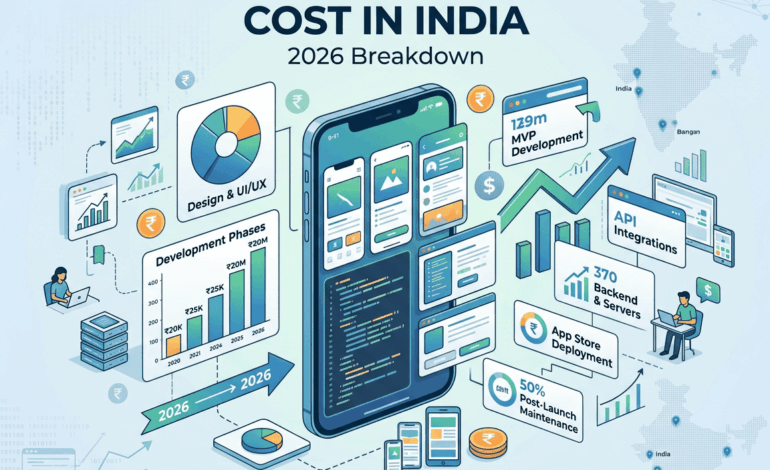
Mobile App Development Cost in India 2026:The Honest Breakdown Nobody Gives You

You spend weeks refining your app idea. You sketch the features, map the user flow, and finally reach out to a few mobile app development costs from different agencies for quotes. Then the responses come in. One says ₹4 lakhs. Another says ₹28 lakhs. A third sends a 12-page proposal that somehow still does not answer the question.
You Have an App Idea. Then You See the Quotes!
You are not confused because the market is complicated. You are confused because most agencies give you numbers without context, and context is everything when it comes to mobile app development cost in India.
This guide cuts through that noise. By the end, you will know exactly what drives app development pricing in 2026, what a realistic budget looks like for your specific idea, and where founders consistently waste money without realising it.
What Does Mobile App Development Cost Actually Include?
Before comparing numbers, understand what you are actually paying for. Most founders assume cost equals coding. It does not.
A complete mobile app development budget covers six distinct components:
UI/UX Design
Covers how your app looks and how users move through it. This is not decoration. Poor design is the number one reason users uninstall apps within the first week.
Frontend Development
The visible layer of every screen, animation, and interaction a user touches.
Backend Development
The engine where servers, databases, APIs, authentication, and business logic running behind the scenes.
Quality Assurance
Is systematic testing across devices, operating systems, screen sizes, and edge cases before a single user touches your product.
Deployment
Covers submitting to the App Store and Google Play, configuring environments, and handling launch logistics.
Post-Launch Maintenance
Is ongoing bug fixes, OS compatibility updates, performance monitoring, and feature iterations.
Miss any of these from your budget estimate and you will run out of money before your app is actually finished.
Real Mobile App Development Cost in India: 2026 Figures
Here is an honest breakdown based on current market rates:
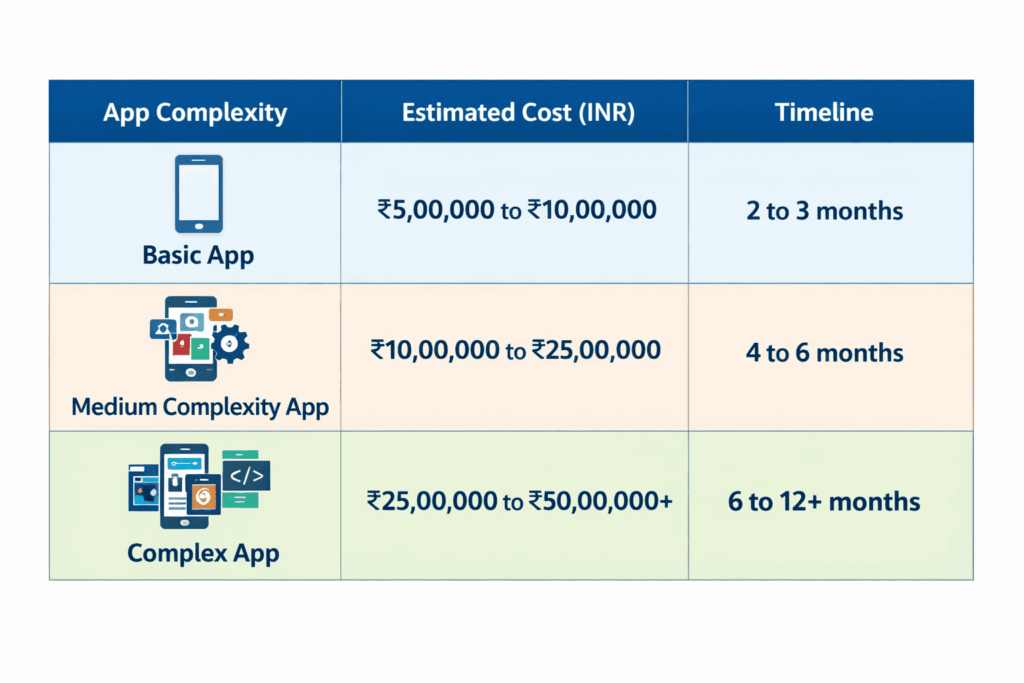
Basic Apps (₹5 Lakhs to ₹10 Lakhs)
These are single-purpose apps with limited backend requirements. Think static content, basic authentication, simple UI, and minimal integrations. A small business directory, a basic appointment scheduler, or a simple utility tool fits here.
If someone quotes you ₹2 Lakhs for a fully functional app with payment integration and real-time features, that is not a deal. That is a warning sign.
Medium Complexity Apps (₹10 Lakhs to ₹25 Lakhs)
This is where most startups actually live. Food delivery platforms, booking apps, service marketplaces, and apps with user profiles, payment gateways, and real-time notifications all fall into this tier.
The range is wide because feature scope varies significantly. A food ordering app with basic delivery tracking sits at the lower end. Add driver tracking, dynamic pricing, loyalty points, and a merchant dashboard and you move toward the upper range.
Complex Apps (₹25 Lakhs to ₹50 Lakhs and Above)
High-performance, enterprise-grade applications: fintech products, social platforms, multi-sided marketplaces, apps with AI and machine learning features, or anything requiring real-time data synchronisation at scale.
These projects are not expensive because agencies are overcharging. They are expensive because the architecture, security requirements, and testing complexity are genuinely substantial.
The 5 Factors That Actually Determine Your App Cost
1. Feature Scope
Every feature has a development cost attached to it. Here are real-world additions and their approximate price impact:
| Sr. No. | Feature | Approximate Cost Addition |
|---|---|---|
| 1 | In-app chat system | ₹ 2,00,000 to ₹ 5,00,000 |
| 2 | Payment gateway integration | ₹ 1,00,000 to ₹ 3,00,000 |
| 3 | AI-powered recommendations | ₹ 5,00,000 and above depends |
| 4 | Push notifications | ₹ 50,000 to ₹ 1,50,000 |
| 5 | Real-time location tracking | ₹ 1,50,000 to ₹ 4,00,000 |
| 6 | Multi-language support | ₹ 1,00,000 to ₹ 2,00,000 |
The fastest way to reduce your initial budget without sacrificing product quality is to ruthlessly separate must-have features from nice-to-have features. Build what users need to get value from your product. Add everything else after your first 1,000 users tell you what they actually want.
2. Platform Choice
Building for Android only, iOS only, or both has a significant cost and timeline impact:
| Platform Strategy | Cost Level | Best For |
|---|---|---|
| Single Platform | Lower | Validating an idea quickly |
| Cross-Platform (Flutter or React Native) | Moderate | Reaching both audiences cost-efficiently |
| Native Both Platforms | Highest | Performance-critical applications |
Cross-platform frameworks have matured considerably. For most startups and SMBs in 2026, Flutter or React Native deliver the right balance of performance, cost, and speed to market. Native development on both platforms simultaneously is reserved for apps where device-level performance is non-negotiable.
3. UI and UX Design Quality
Design is where founders most commonly try to cut costs. This is almost always a mistake.
A well-designed UX reduces churn, improves conversions, lowers your support volume, and directly impacts how users perceive your brand.
The upfront cost of good design is almost always lower than the ongoing cost of fixing a product users find frustrating.
Budget 10 to 20 percent of your total project cost for design and treat it as a revenue investment rather than an aesthetic expense.
4. Development Team Structure
India offers three options: freelancers, boutique agencies, and full-service development companies. Each carries a different risk-to-cost profile:
| Team Type | Cost | Risk | Best For |
|---|---|---|---|
| Freelancers | Lower | Highest | Small, well-defined tasks |
| Boutique Agencies | Moderate | Moderate | Focused product builds |
| Full-Service Companies | Highest | Lower | End-to-end complex projects |
A freelancer quoting ₹3L for a medium-complexity app is not saving you money. They are front-loading risk onto your project in the form of timeline delays, accountability gaps, and rework costs that you will pay for later.
5. Backend Complexity
Apps with user accounts, real-time data, cloud storage, third-party integrations, and high concurrent user loads require backend infrastructure that adds significantly to both development cost and ongoing operational cost.
A chat-based service app needs a fundamentally different backend than a static content app, and the pricing reflects that reality.
The Hidden Costs That Destroy App Budgets
This is where most cost guides fail you completely. The quoted development price is only part of what you will spend:
Annual Maintenance:
Budget 15 to 20 percent of your initial development cost every single year. iOS and Android release major OS updates annually. If your app is not updated to stay compatible, it breaks. This is not optional.
Server and Hosting:
Cloud infrastructure on AWS, Google Cloud, or Azure runs anywhere from ₹5,000 to ₹1,00,000 or more per month depending on your user load and data requirements.
Third-Party API Costs:
Payment processors, mapping services, SMS gateways, push notification services, and analytics platforms all carry usage fees that grow as your user base grows.
App Store Fees:
Apple charges an annual developer fee of $99. Google charges a one-time $25 registration fee.
Marketing and User Acquisition:
This is the cost almost every first-time founder forgets to budget for. Building the app gets you to the starting line. Getting users onto it is an entirely separate investment.
A realistic total-cost picture for a medium-complexity app over its first year looks more like ₹15L to ₹35L once you factor in maintenance, infrastructure, APIs, and initial marketing spend.
How to Estimate Your Own App Cost in 6 Steps
You do not need a technical background to build a credible budget estimate:
- Write your app idea in one clear sentence
- List every feature you want at launch be specific
- Mark each feature as Must-Have or Nice-to-Have and cut the second list entirely for now
- Choose your platform: Android, iOS, or both
- Decide your design tier: functional, polished, or premium
- Request itemised quotes from at least three development teams
Itemised quotes are the key word in that last step. A quote that simply states “app development: ₹15 Lakhs” tells you nothing about where the money goes, what is included, or what will cost extra. You want line-item visibility into design hours, development hours per feature, QA cycles, and deployment support.
Is India Still Worth It for App Development in 2026?
Directly: Yes. India remains one of the most cost-competitive destinations for mobile app development globally, and the quality of talent has continued to improve.
The more important shift in 2026 is that the strongest Indian development partners now think in products rather than just in code. The best teams ask about your retention strategy, your monetisation model, and your scalability requirements before they discuss technology choices.
When evaluating a mobile app development partner, the questions they ask you in the first conversation tell you more about their quality than their portfolio does. A team that jumps straight to tech stack recommendations without understanding your business problem will build you exactly what you asked for and probably not what you actually needed.
Final Thoughts
Mobile app development cost in India in 2026 is not arbitrary. It responds directly to what you are building, how complex it is, which platforms you target, and who you trust to build it.
The founders who manage app budgets well are not the ones who spend the least. They are the ones who allocate strategically to investing in design, protecting their feature scope, planning honestly for post-launch costs, and choosing a development partner based on how well they understand the business problem rather than how low their quote is.
Your app is not a line item. It is a business asset. Budget for it like one. If you are ready to move from estimation to execution, start with a team that asks harder questions about your users and your goals than they do about your deadline. That conversation is what separates apps that generate revenue from apps that simply exist.
⚠ Disclaimer:
This article is contributed by an independent author and is for informational purposes only. We do not guarantee its accuracy or completeness. The views expressed are those of the author and do not reflect this website. Readers should verify information independently and consult professionals where necessary.