
What Are Needle Holders? Types, Uses, and Essential Guide
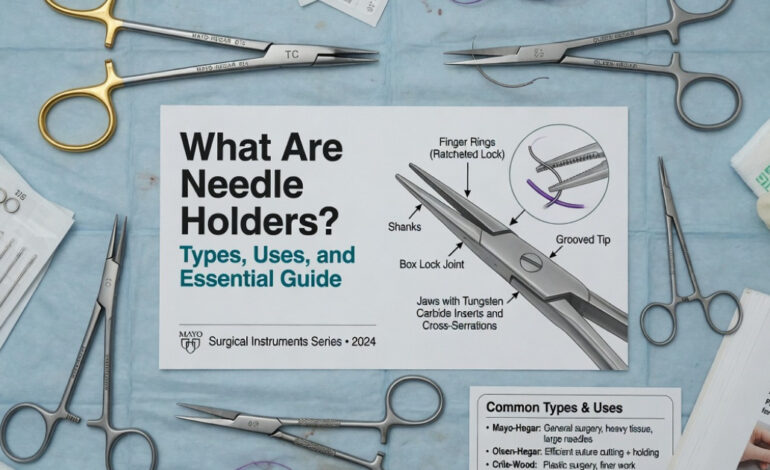

Needle holders are crucial tools within any operating room. They are used by surgeons to hold and push suture needles. Without them, it would be almost impossible to do accurate suturing. A surgical needle holder makes sure that there is control in sensitive procedures.
It provides stability and fixation of the needle. If you are a surgeon or paramedic, you must know the importance of a high-quality needle holder in the OT and emergency rooms.
The global surgical instruments market was valued at USD 10.36 billion in 2024 and is projected to reach USD 19 billion by 2032, growing at a CAGR of 7.88%. We delve into types, applications, and important characteristics.
This article will cover all the necessary details about needle holders that every medical practitioner should know.
Let’s get started.
What are Needle Holders?
Surgical instruments that hold suture needles are known as needle holders. They look like scissors, but they work in a different manner. The jaws firmly squeeze the needle. This provides the surgeon with complete direction. They can also be referred to as needle drivers or suture needle holders. Clinically, the terms are used interchangeably.
Key characteristics include the following:
- Ratcheted handle so that it securely grips
- Tungsten carbide or stainless steel jaws
- A variety of jaw sizes to fit needle gauges
- Finger ring handles that are ergonomic to move with
What is the Use of Needle Holders in Surgery?
One of the most important steps in surgery is suturing. An effective suture needle holder enhances accuracy. It lessens hand fatigue in the lengthy processes. It also eliminates needle-stick injury to the surgeon. Suture placement can be jeopardized by poor-quality instruments. It can have a direct impact on patient outcomes. There is no need to compromise on quality needle drivers.
Types of Surgical Needle Holders
Various processes will demand a varied design of instruments. The most widespread ones are:
-
Mayo-Hegar Needle Holder:
It is the most common design throughout the world. It is a box, locked and straight-jawed. It applies to general surgical sutures. The ratchet mechanism ensures that the needle is held firmly.
-
Crile-Wood Needle Driver:
This instrument is more slender and longer. It is best in the deeper fields of surgery. It is used by surgeons in abdominal and thoracic surgeries. It provides great control of the needle depth.
-
Castroviejo Needle Holder:
This is a delicate, spring-action instrument. It finds applications in ophthalmic surgery and microsurgery. Very small suture needles are dealt with by the fine jaws. It involves minimal hand movements in order to work accurately.
-
Webster Needle Holder:
This is a smaller copy of the normal holders. It is normally applied in cosmetic and plastic surgery. It deals with small needles that are used in sewing the skin.
-
Mathieu Needle Holder:
This tool involves a ratchet in the front. It allows a different gripping technique. It is popular in dental and oral surgeries.
Key Features to Look for in a Suture Needle Holder
The selection of the appropriate tool is important. This is what to consider:
- Jaw material: Tungsten carbide jaws are more resilient and have a better grip
- Handle design: Ergonomic rings make the surgeon less tired
- Locking system: A smooth ratchet enhances control
- Length: Adjust the instrument length to the surgical site
- Weight: Less weight in instruments eases the strain on hands
- Sterilization compatibility: Should be able to withstand repeated autoclaves
Needle Holders vs. Hemostatic Forceps: Know the Difference
Most of the novices mix up these two instruments. Hemostatic forceps are used to clamp blood vessels. Needle drivers receive and give out suture needles. Each purpose has a different structure of its jaws. The improper tool raises the chances of danger and diminishes accuracy. Always confirm the instrument prior to use.
How to Maintain Surgical Needle Holders
Good care prolongs the life of your instruments.
- Wipe instruments after use
- Cleanse tissue debris by use of enzymatic cleaners
- Check jaws on a regular basis for wear or misalignment
- Grease the box lock to avoid stiffness
- Autoclave at the suggested temperature and pressure
- Immediately replace instruments that are damaged to the jaw
Where to Buy Quality Needle Holders?
Selection is as important as sourcing. Always purchase from certified suppliers of surgical instruments. Find manufacturers that are ISO-certified. Confirm materials are of ASTM or DIN standards. Determine whether the supplier has a stable bulk rate. Good after-sales services are also essential.
GerMedUSA has a refined collection of needle holders and surgical needle holders to be used in the clinic and surgical field. To view options.
FAQs
Q1: What is a needle holder used for in surgery?
Suture needles are pushed into tissue via a needle holder. It provides surgeons with control during the wound closure. It also averts needle-stick injuries accidentally.
Q2: What is a needle driver?
The two terms are used to denote the same instrument. The clinical term is “needle driver,” which is more contemporary. The common and still prevalent name is needle holder.
Q3: What is the best needle holder to use in general surgery?
The Mayo-Hegar needle holder is best for general surgery. It is ubiquitous, long-lasting, and user-friendly. It is a common instrument in a majority of surgical trays.
Q4: What is the correct size of the needle holder that I should use?
Compare the size of your jaw to your suture needle gauge. The longer tools are more effective in deep surgery. The shorter ones are more in control of surface-level processes.
Q5: Are tungsten carbide needle holders worth the money?
Yes, tungsten carbide jaws are better at gripping and lasting. They are more resistant to wear compared to ordinary stainless steel jaws. They justify the price in large-volume surgical environments.
Q6: Will needle holders be reusable with sterilization?
Yes, the majority of surgical needle holders can be reused. They must be properly cleaned and autoclaved after each use. Add a check before reuse, always inspect to ensure that there is no damage.
Q7: What is the cause of wear in needle holders’ jaws?
Clamping of hard needles repeatedly results in wear of the jaw with time. Damage is hastened with the incorrect size holder. Wear can be detected early with regular inspection.
⚠ Disclaimer:
This article is contributed by an independent author and is for informational purposes only. We do not guarantee its accuracy or completeness. The views expressed are those of the author and do not reflect this website. Readers should verify information independently and consult professionals where necessary.