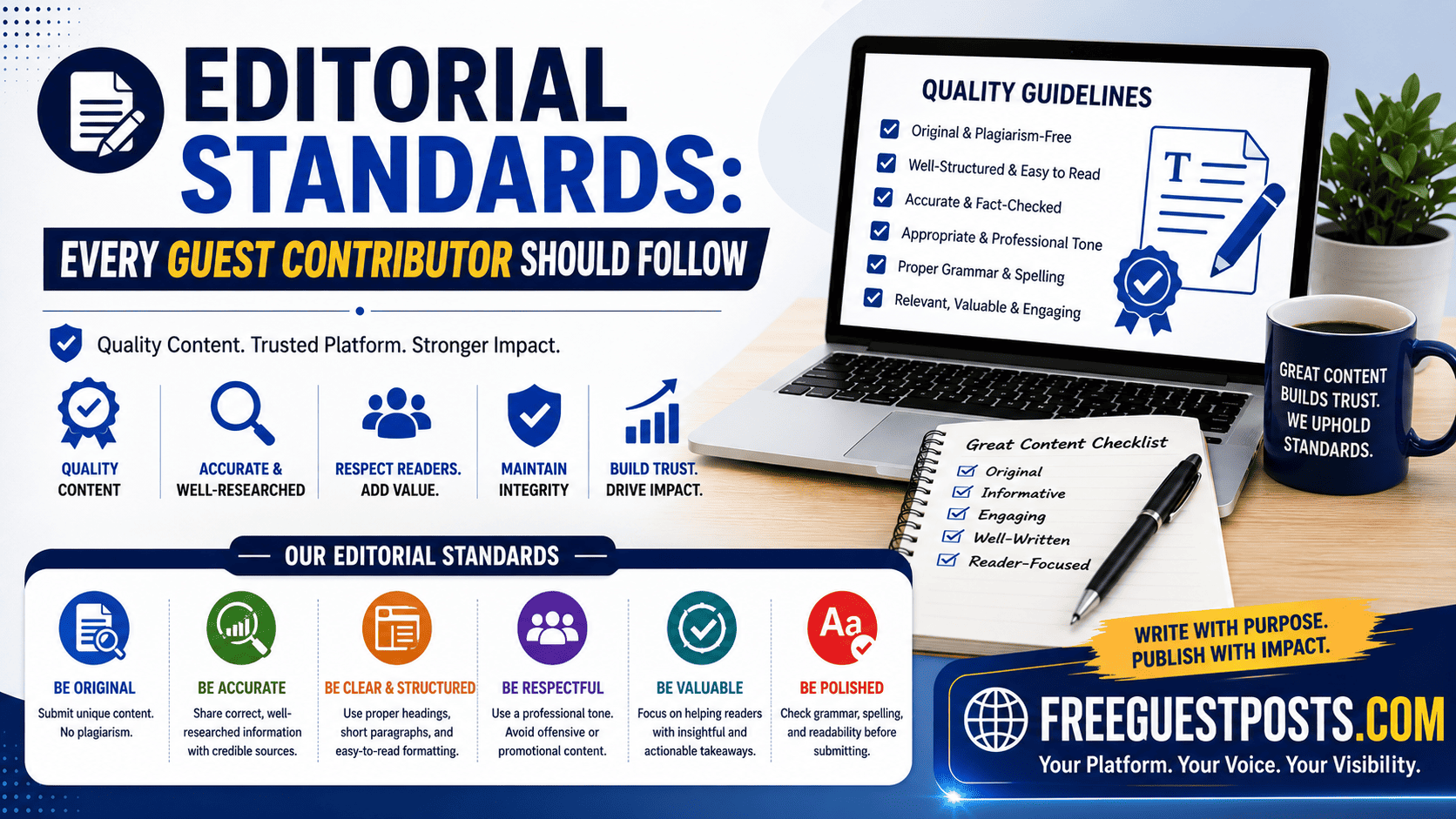
Editorial Standards: Every Guest Contributor Should Follow

There’s a version of guest posting that helps everyone involved: the contributor gets a quality backlink and a new audience, the publisher gets genuinely useful content, and the reader walks away having learned something real. Then there’s the other version, thin articles stuffed with keywords, author bios that read like press releases, and links shoehorned into places they have no business being.
The difference between the two isn't talent. It's editorial standards.
Most contributors, if they’re honest, haven’t had anyone sit down with them and explain what professional editorial standards actually look like in practice. They’ve read a few “how to guest post” guides that focus on finding platforms and sending outreach emails and not nearly enough about what happens after the pitch lands. What makes an article genuinely publishable. What editors are really looking for when they read your draft. What separates a submission that sails through review from one that gets quietly archived.
This guide is that conversation. We’ll cover every major standard you need to understand, from structure and originality through to E-E-A-T compliance, link usage, and the formatting details that separate an amateur submission from a professional one. By the time you’ve read it, you’ll know exactly what “editorial quality” means in practice, and exactly how to hit that standard every single time you submit.
|
73% of guest post rejections are due to content quality issues, not topic fit |
94%
of editors say originality is their single most important acceptance criterion |
3.2x
more likely to be accepted if the article demonstrates first-hand expertise |
|---|---|---|
| 68% of submitted guest posts are rejected for not following formatting guidelines |
40%
traffic increase for publishers that enforce strict editorial standards |
1,000+ words minimum for editorial consideration on most quality platforms in 2026 |
Why Editorial Standards Exist! Why they Matter More Than Ever!!
Editorial standards aren’t arbitrary rules. Every standard a publication sets exists because it has learned, through experience, what kind of content serves its readers well and what doesn’t.
But in 2026, editorial standards matter more than they ever have for a reason that has nothing to do with individual publications: Google’s E-E-A-T framework.
E-E-A-T stands for Experience, Expertise, Authoritativeness, and Trustworthiness! The four dimensions Google’s quality raters use to assess whether a piece of content deserves to rank well. When a guest contributor follows proper editorial standards, they’re not just satisfying an editor’s personal preferences. They’re producing content that Google’s own guidelines define as high quality.
AI-generated content has flooded the internet since 2023. The sheer volume of machine-produced articles has made genuine, experience-backed, editorially-reviewed content more valuable than ever, both to readers looking for something real and to search engines trying to surface it. Following editorial standards is, in 2026, the clearest way to signal to every audience that matters that your content is the real thing.
Google's 2024–2025 Helpful Content and Core updates significantly increased the weight given to E-E-A-T signals.
Content demonstrating genuine first-hand experience now ranks measurably higher than expert-sounding but experience-free articles on the same topic.
Before you submit your next article, whether it’s for Free Guest Posts or any other platform, understanding these standards is the single most valuable thing you can do for your long-term results as a contributor.
Standard 1: Originality Non-Negotiable Foundation
Let’s start with the one that gets more submissions rejected than any other: originality. And I want to be specific here, because “original content” means something more precise than most contributors realise.
Original content means the article has not been published elsewhere not on your own blog, not in a slightly modified form on another guest posting platform, not as a repurposed section of an older piece. It means the ideas, the framing, and the writing itself is new. Even if the topic has been covered a thousand times before, your specific treatment of it, the examples you use, the angle you take, the conclusions you draw must be original to this submission.
This matters for three distinct reasons. First, search engines penalise duplicate content, publishing the same article in two places creates a competing signal that dilutes both. Second, editors can check plagiarism and similarity within seconds using tools like Copy scape or Grammarly; submissions that fail these checks are rejected without discussion. Third, and most importantly from a quality standpoint: if your article isn’t genuinely new, there’s no reason for the platform’s readers to read it. They’ve already read the version that exists.
Submitting the same article to multiple platforms simultaneously is a common mistake that gets contributors permanently blocked from quality platforms.
Always submit exclusively and wait for a decision before pitching the same article elsewhere.
What originality looks like in practice?
Original content doesn’t mean you have to invent a topic no one has thought of before. It means you have to bring something to a topic that wasn’t already there. Your experience, your data, your counterintuitive observation, your specific example. The article should contain at least one element that could only have been written by you, something a generative AI or a generic content mill couldn’t have produced, because it comes from actual lived knowledge.
If you find yourself writing an article that could be summarized as “here are the top five tips for [topic that has ten million Google results,” stop and ask yourself: what do I know about this that those ten million results don’t already contain? If the answer is nothing, find a different angle before you write a word.
Standard 2: Structure and Readability
Editorial quality isn’t just about what you say. It’s about how you structure it so readers can actually absorb and use it. Even the most expert, genuinely original content fails if it’s presented as an undifferentiated wall of text with no navigational signposts.
Professional editorial structure has a few non-negotiable components that every submission should include.
The introduction: earn the read in 100 words
Your opening paragraph has one job: to make the reader decide to keep reading. This sounds obvious, but most introductions fail it. The most common failure mode is the “context dump” opening three paragraphs of background information that the reader didn’t ask for before you get to the point.
A strong editorial introduction does one of three things: it opens with a tension or problem that the reader recognizes from their own experience; it makes a counterintuitive claim that creates genuine curiosity; or it immediately signals that the article knows something specific and useful that the reader doesn’t. All three approaches earn the read. Background-dumping doesn’t.
Headings: navigation, not decoration
H2 and H3 headings should function as a navigational outline of your article, someone who reads only the headings should be able to understand the article’s structure and decide which sections they want to read first. Headings that are vague (“More considerations”), rhetorical (“Why does this matter?”), or decorative serve no editorial purpose.
Good headings are specific and informative. They tell the reader exactly what the section covers and they’re written with search intent in mind, because headings are weighted by search engines as content signals.
Paragraph length and white space
Online reading is fundamentally different from reading a book or a long-form essay in print. Paragraphs longer than four to five sentences become difficult to scan, and most online readers scan before they commit to reading. Keeping paragraphs short: two to four sentences for most body sections creates the white space that makes an article feel readable before the reader has processed a word of it.
Editorial Standards at a Glance
| Sr. No. | Standard | What it requires | Common Failure | Status |
|---|---|---|---|---|
| 1 | Originality | 100% new, not published elsewhere, unique treatment of topic | Recycled or repurposed articles submitted to multiple platforms | Must Have |
| 2 | Structure | Strong intro, specific H2/H3 headings, 2–4 sentence paragraphs | Wall-of-text formatting, vague or decorative headings | Must Have |
| 3 | E-E-A-T compliance | First-hand experience evident, expertise demonstrated through content | Generic coverage with no personal perspective or specific examples | Must Have |
| 4 | Link quality | Max 2 contextual links; descriptive anchor text; links genuinely add reader value | Exact-match anchors; links inserted to satisfy SEO not reader need | Must Have |
| 5 | Factual accuracy | All specific claims cited to credible, primary sources | Uncited statistics; summaries of summaries; outdated data | Must Have |
| 6 | Human voice | Genuine perspective, personal examples, non-AI-pattern prose | AI-generated or heavily AI-edited content lacking individual POV | Must Have |
| 7 | Author bio | 2–4 sentences, third person, credibility-focused, relevant link | Over-long bio; promotional tone; link to irrelevant page | Required |
| 8 | Submission format | Meets platform word count, format, and image specs | Incorrect format; missing components; wrong word count range | Required |
| 9 | Editorial conduct | Prompt responses; professional feedback engagement; post-publication promotion | Slow responses; arguing changes; ghosting after publication | Best practice |
Standard 3: E-E-A-T – Experience, Expertise, Authoritativeness, Trustworthiness
E-E-A-T is Google’s quality framework, but it’s more useful to think of it as a reader’s framework. When a reader encounters any piece of content, they’re implicitly asking four questions: did this person actually experience what they’re writing about? Do they know what they’re talking about? Is this source credible in this space? Can I trust the information here? Editorial standards that satisfy E-E-A-T satisfy all four of those reader questions simultaneously.
You can learn more about the principles behind strong guest content in our guide to what guest posting really means.
Experience: the “first E“
The Experience criterion is the most recent addition to Google’s framework and arguably the most significant for guest contributors. It asks a simple question: does the person who wrote this article have direct, first-hand experience with the subject matter?
An article about building a morning routine written by someone who has actually experimented with their morning routine for months carries a different kind of authority than the same article written by someone who researched it from other articles. Readers can usually feel the difference and so can editorial reviewers. Include specific details, real outcomes, and personal examples wherever the topic permits them.
Expertise: show your knowledge, don’t just claim it
Expertise is demonstrated, not declared. An author bio that says “Jane is an expert in digital marketing” adds nothing. An article that explains a complex concept clearly, anticipates common misconceptions, and provides specific evidence for its claims demonstrates expertise without announcing it. The writing itself is the proof.
Authoritativeness and trustworthiness
Authoritativeness builds over time as your name becomes associated with quality work across multiple publications. Trustworthiness is established within a single article through accurate claims, properly attributed sources, appropriate caveats where uncertainty exists, and an author bio that gives readers enough context to evaluate the writer’s credibility.
For YMYL topics finance, health, legal advice trustworthiness standards are higher. If you’re writing about any of these areas, include a disclaimer where appropriate and be conservative about definitive claims in areas where qualified professional advice should be sought.
E-E-A-T signals: what Google and AI engines look for
| Sr. No. | E-E-A-T signal | Strong Indicators | Weak indicator | AI citation impact |
|---|---|---|---|---|
| 1 | Experience | Specific personal examples, time-bounded experiments, named outcomes | Generic overview with no first-person angle | High positive |
| 2 | Expertise | Technical accuracy, anticipates common misconceptions, original analysis | Content that could have been written by anyone | High positive |
| 3 | Authoritativeness | Named author with verifiable publishing history; cited by others | Anonymous or unverifiable author credentials | Moderate |
| 4 | Trustworthiness | Primary source citations, appropriate caveats, honest about uncertainty | Uncited claims, overconfident assertions, no caveats | High Positive |
| 5 | Unique data / research | Original statistics, survey results, first-hand findings | Secondary sourcing of other people’s stats | Very High Positive |
| 6 | Human voice | Specific perspective, genuine opinions, non-formulaic structure | AI-pattern prose, comprehensive but impersonal | High Positive |
| 7 | Structured data / schema | FAQ, How To, Article JSON-LD correctly implemented | No schema or incorrectly implemented | Moderate |
Standard 4: Links the most misunderstood element of guest posting
Links are frequently the reason a guest post is submitted in the first place. They’re also one of the most common reasons submissions get rejected or edited heavily before publication. Understanding the editorial rules around linking is essential to building a sustainable guest posting practice.
Our full editorial process covers link policies in detail, but here are the principles every contributor should understand before submitting.
The contextual link rule
A contextual link the one that points back to your site from within the article body must be genuinely contextual. It should appear where it naturally makes sense, pointing to a resource that genuinely adds value to the reader. The test is simple: if you removed the link, would the surrounding sentence still make complete sense and serve the reader well? If yes, the link placement is likely good. If the sentence was written primarily to justify the link’s existence, it will read that way and editors notice immediately.
Anchor text best practice
The anchor text the clickable words that form the link should be descriptive and natural. It should tell the reader something accurate and useful about where the link goes. Exact-match commercial keywords as anchor text (“best SEO agency,” “buy cheap flights”) are a red flag for both editors and search engines. They look manipulative because they are. Branded or descriptive anchors (“more on Free Guest Posts’ approach to editorial standards”) are both safer and more likely to generate actual clicks.
How many links is too many
Most quality platforms allow one contextual do follow link within the article body and one link in the author bio. Some allow two contextual links in longer pieces. Any submission with three or more outbound links regardless of their quality will almost always be flagged for heavy editing or rejection. Self-impose a two-link maximum on every submission and save yourself the revision request.
Link Usage: What Passes and What Fails Editorial Review
| Sr. No. | Link Type | Example | Editorial Verdict | Reasons |
|---|---|---|---|---|
| 1 | Descriptive Contextual Anchor | As covered in ‘Free Guest Posts’ editorial guide | Passes | Tells reader what to expect: natural placement |
| 2 | Branded Anchor | amazon.com | Passes | Brand references are natural and non-manipulative |
| 3 | Partial-match anchor | Guest Posting Guidelines | Passes | Descriptive, non-commercial, contextually relevant |
| 4 | Exact-match commercial anchor | best free guest posting site | Fails | Google spam policy violation; editorial red flag |
| 5 | Over-linked article (3+ outbound) | Multiple self-promotional links throughout | Fails | Exceeds standard limits: appears as link-scheme signal |
| 6 | Irrelevant contextual link | Finance link inserted into a travel article | Fails | No topical relevance; adds no reader value |
| 7 | Sponsored link without rel=”sponsored” | Paid placement tagged as editorial | Fails | Google guidelines require sponsored tag; misleads readers |
| 8 | Author bio link (homepage) | Link to writer’s main website in bio | Passes | Standard practice; expected and compliant |
Standard 5: Factual Accuracy and Source Citation
An article that makes claims it can’t support is worse than no article at all. Readers who encounter an inaccuracy lose trust not just in that article but in every other article on that platform. Editors who catch an inaccuracy in review lose trust in that contributor permanently, in most cases.
Every specific claim in your article that goes beyond general knowledge should be supported by a credible, verifiable source. Statistics, research findings, technical specifications, historical facts all of these should link to or cite an authoritative original source. Not a summary of a summary of a press release. The actual study, the official data release, the primary document.
Where data is uncertain, say so. Where expert opinion varies, represent that variation accurately. Where your own experience is the primary source, make that clear. Intellectual honesty including about the limits of your own knowledge is itself an editorial standard. It’s also what makes your content trustworthy to the AI engines that are increasingly making citation decisions.
Standard 6: Tone, Voice, and Human Element
The rise of AI-generated content has created a strange situation for editorial standards. There is now a recognizable “AI voice” a particular pattern of confident, well-structured, comprehensive, and oddly impersonal prose that readers encounter everywhere and which has begun to erode trust in online content generally. The editorial standard that has become most important in response is the one that has always mattered most, but was harder to articulate when human written content was the only option: genuine human voice.
Human voice in editorial writing isn’t the same as casual or colloquial writing. It means writing that has a specific perspective, makes genuine arguments, admits uncertainty where it exists, and occasionally says things that a machine optimizing for comprehensiveness and safety would never say. It means writing that takes positions. Writing that brings a point of view to the topic, not just a thorough coverage of it.
The practical implication for contributors: don’t write to cover everything. Write to say something. The difference between an article that editors love and one they quietly decline is often not a matter of factual completeness it’s a matter of whether the writer had a genuine perspective that came through.
Standard 7: Author Bio: Most Underestimated Part of Your Submission
Most contributors write their author bio as an afterthought. This is a mistake. The author bio is the one part of a guest post that every reader who enjoyed the article will read and it’s the primary mechanism through which a guest post converts a reader into a follower, subscriber, or lead.
A professional author bio does three things: it establishes the writer’s credibility on the specific topic of the article (not in general); it gives the reader a reason to care who the writer is; and it includes a clear, relevant link that invites the reader to continue the relationship somewhere else.
Two to four sentences is the right length. More than that reads as self-promotional. Third person is the editorial standard on most platforms. And the link in the bio should point to the most relevant destination for the article’s audience a related resource, a newsletter sign-up, or a portfolio page not just a homepage.
Standard 8: Submission Formatting the Signal Before the Signal
How you format your submission before it arrives in an editor’s inbox tells them something about you before they’ve read a word. A submission that arrives in the specified format, at the specified length, with all the specified components, signals that you read the guidelines and respect the platform’s time. That signal entirely separate from the quality of the writing affects how the subsequent reading experience is framed.
Read the submission guidelines on every platform you pitch, every time, even if you’ve submitted there before. Guidelines change. A platform that accepted articles without images last year may now require at least one. A word count range that was 800–1,200 words may have shifted upward. Checking takes three minutes. Sending an incorrectly formatted submission costs you significantly more than that.
Pre-Submission Checklist
Before you hit send on any guest post submission, run through this list. Every item should be confirmed:
Pre-submission editorial checklist
- Word count meets the platform’s minimum (typically 1,000–1,500 words)
- Article is 100% original and not published (or currently submitted) elsewhere
- Topic has not been covered on the target platform in the past 6–12 months
- Introduction earns the read in the first 100 words
- H2 and H3 headings are specific and navigational (not vague or decorative)
- Paragraphs are 2–4 sentences on average
- All factual claims are supported by a credible, citable source
- Maximum two outbound links in the article body; anchor texts are descriptive, not exact-match commercial
- E-E-A-T signals present: first-hand experience noted, expertise demonstrated through content
- Writing voice is genuine and human not AI-pattern prose
- Author bio is 2–4 sentences, third person, credibility-focused, with relevant link
- Images (if required) are royalty-free, correctly attributed, minimum required dimensions
- Submission format matches platform requirements (Google Doc, Word, plain text, or CMS)
- Guidelines for the specific platform re-read within the last 30 days
Common Rejection Reasons and How to Fix Them
| Sr. No. | Rejection Reason | % of Rejections (est.) | Fixes |
|---|---|---|---|
| 1 | Thin or low-value content | 31% | Add specific examples, data, and personal experience to every major claim |
| 2 | Not following guidelines | 22% | Re-read the platform’s guidelines on the day of submission, not the day you pitched |
| 3 | Off-topic for platform audience | 19% | Read 3–5 recent published articles on the platform before writing |
| 4 | AI-generated or AI-heavy content | 12% | Write sections requiring personal perspective from scratch; use AI only for structural assistance |
| 5 | Duplicate / previously published | 9% | Only submit original content; run your draft through Copyscape before submitting |
| 6 | Link policy violations | 7% | Max 2 links, descriptive anchors, links contextually justified — always |
Standard 9: AI tools use them as an assistant, not an author
This section is necessary in 2026 in a way it wouldn’t have been three years ago, and it’s worth being direct: using AI tools to assist your writing is broadly accepted. Using AI tools to write your submission and submitting it as your own work is not.
The distinction matters practically, not just ethically. AI-generated content, even when it’s accurate and well-structured, consistently fails the experience criterion of E-E-A-T because by definition it has no experience to draw on. It can reference experiences. It can describe what experience might look like. But it cannot bring the specific, particular, first-hand knowledge that a human writer with genuine background in a subject brings to an article. Editors trained to review content can feel this absence in the same way they can feel the presence of genuine voice when it’s there.
Practical guidance: use AI tools for outlining, for identifying gaps in your structure, for rephrasing sentences that aren’t quite landing, and for checking factual consistency. Don’t use them to generate the sections of your article that require your actual perspective the examples, the observations, the conclusions, and the voice that makes your writing yours.
Standard 10: Respecting the editorial relationship
Editorial standards aren’t just about the article. They’re about how you conduct yourself as a contributor throughout the process. This matters more than most people realise publications talk to each other, and a reputation for being difficult to work with travels faster than a reputation for good writing.
What professional editorial conduct looks like in practice:
Respond to editorial feedback promptly within 48 hours is the standard most editors expect
Treat editorial suggestions as professional input, not criticism. An editor who has taken the time to provide detailed feedback is investing in your submission
If you disagree with a requested change, explain your reasoning clearly and once then defer to the editor’s final call if they maintain the request. Don’t ask for status updates more than once per week during the review period. If you withdraw a submission, notify the editor promptly so they’re not holding space for an article that’s no longer coming
After publication, promote the article. Platforms track whether contributors promote their work contributors who do are far more likely to be invited back
Editorial Standards: Separate Good Contributors From Great Ones
Everything we’ve covered so far is the baseline. The contributors who get invited back, who get better placement, and who build genuine relationships with editorial teams over time do something beyond the baseline: they think about the reader’s experience from the first word to the last, not just their own goals for the submission.
The best guest post you’ll ever write won’t feel like a guest post when someone reads it. It will feel like the most useful article they found on that topic one that happened to be written by someone with a name and a link worth clicking. That’s the editorial standard worth holding yourself to. Not “will this pass review?” but “will this actually help someone?”
That standard, consistently applied, is what separates a contributor who earns one backlink from a contributor who earns a community, a reputation, and a genuine publishing relationship that compounds over years.
Ready to apply these standards to your first or next submission? Review our full contributor guidelines, explore the platform’s live niche categories, and submit your article free. Editorial review typically takes 3–5 business days, and approved articles go live with a do follow backlink to your chosen URL.
Write to editorial standards get published free Free Guest Posts Platform applies genuine editorial review to every submission.
FAQs
Q1: What are editorial standards in guest posting?
A: Editorial standards are the quality criteria a publication applies when reviewing guest post submissions. They typically cover originality (the article must be unpublished and uniquely written), structure (clear headings, appropriate length, readable paragraphs), factual accuracy (claims supported by credible sources), link policy (how many outbound links are permitted and what anchor texts are acceptable), E-E-A-T compliance (evidence of first-hand experience and genuine expertise), and formatting requirements specific to the platform. Meeting these standards is the difference between a submission that sails through review and one that gets rejected or returned for significant revision.
Q2: Why do most guest posts get rejected?
A: Most of the common reasons for guest post rejection, in order of frequency, are: thin or low-value content that doesn’t add something new to the topic (31% of rejections); not following the platform’s specific submission guidelines (22%); off-topic submissions that don’t fit the platform’s audience (19%); AI-generated or heavily AI-assisted content lacking genuine human perspective (12%); duplicate or previously published content (9%); and link policy violations such as exact-match anchors or too many outbound links (7%). Most rejections are preventable, they result from not reading guidelines carefully or not bringing genuine expertise and specificity to the article.
Q3: What is E-E-A-T and why does it matter for guest posts?
A: E-E-A-T stands for Experience, Expertise, Authoritativeness, and Trustworthiness. Google’s framework for assessing content quality. For guest contributors, the most important signals are Experience (does the article demonstrate that the writer has real, direct knowledge of the subject?) and Trustworthiness (are claims accurate, well-sourced, and appropriately caveated?). Since Google’s 2024–2025 algorithm updates, E-E-A-T compliance has become a measurable ranking factor. Articles that demonstrate genuine first-hand experience rank measurably better than technically accurate but experientially empty content. For AI citation visibility in tools like ChatGPT and Perplexity, these signals matter equally.
Q4: Can I use AI tools to write my guest post?
A: Using AI tools to assist your writing process is accepted, using them to write your submission and passing it off as your own is not. The practical distinction matters: AI can help you outline, identify structural gaps, rephrase sentences, and check factual consistency. But sections that require genuine first-hand experience, personal perspective, specific examples, and individual voice must be written by you. Most quality platforms now use AI-detection tools in their editorial review process. Fully AI-generated content consistently fails the E-E-A-T experience criterion and is returned for revision or rejected. Write the substance yourself; use AI only for editorial polish.
Q5: How many links can I include in a guest post?
A: The standard on most quality platforms is a maximum of two outbound links in the article body — typically one contextual link to a relevant resource on your own site, and in some cases one additional link to a credible external source. A second link is usually permitted in the author bio pointing to your homepage or a relevant landing page. Any submission with three or more outbound links will almost certainly be flagged for editing or rejection. Self-impose a two-link maximum on every submission and make sure both links are contextually justified, placed where they genuinely add reader value, not where they benefit your SEO.
Q6: What should a guest post author bio include?
A: A professional author bio should be two to four sentences written in the third person. It should establish the writer’s specific credibility on the topic of the article, not their general life story, give the reader a reason to care who this person is, and include one relevant link that invites continued engagement. The link should point to the most valuable destination for that article’s specific audience: a related resource, a newsletter sign-up, or a portfolio page. Overly promotional bios, first-person bios, and bios longer than four sentences are all common editorial complaints. Keep it concise, credibility-focused, and reader-first.
Q7: How do editorial standards affect SEO and AI search visibility?
A: Editorial standards directly improve both traditional SEO and AI engine visibility in 2026. For Google rankings, content that demonstrates E-E-A-T signals, genuine experience, credible expertise, accurate sourcing, receives preferential treatment in the post-2024 algorithm updates. For AI citation visibility in ChatGPT, Perplexity, and Gemini, the signals that drive citation are: specific statistics with attribution, structured Q&A content (FAQ schema), original analysis or data not found elsewhere, and clear entity associations. Articles that follow editorial standards naturally produce most of these signals, which means editorially-reviewed guest posts are significantly more likely to be cited by AI engines than generic content published without review.
Q8: What is the minimum word count for a quality guest post?
A: Most quality guest posting platforms in 2026 set a minimum of 1,000 words for editorial consideration, with 1,200–1,500 words being the most common range for standard submissions. Deeper, more competitive topics, technical guides, comprehensive how-tos, research-backed analysis, typically warrant 1,500–2,000 words. The right length is the one that covers the topic completely without padding: every section should exist because it adds something, not because it gets the article closer to a word count. Artificially inflated articles are easy for editors to spot and reflect poorly on the contributor regardless of the quality of the core content.