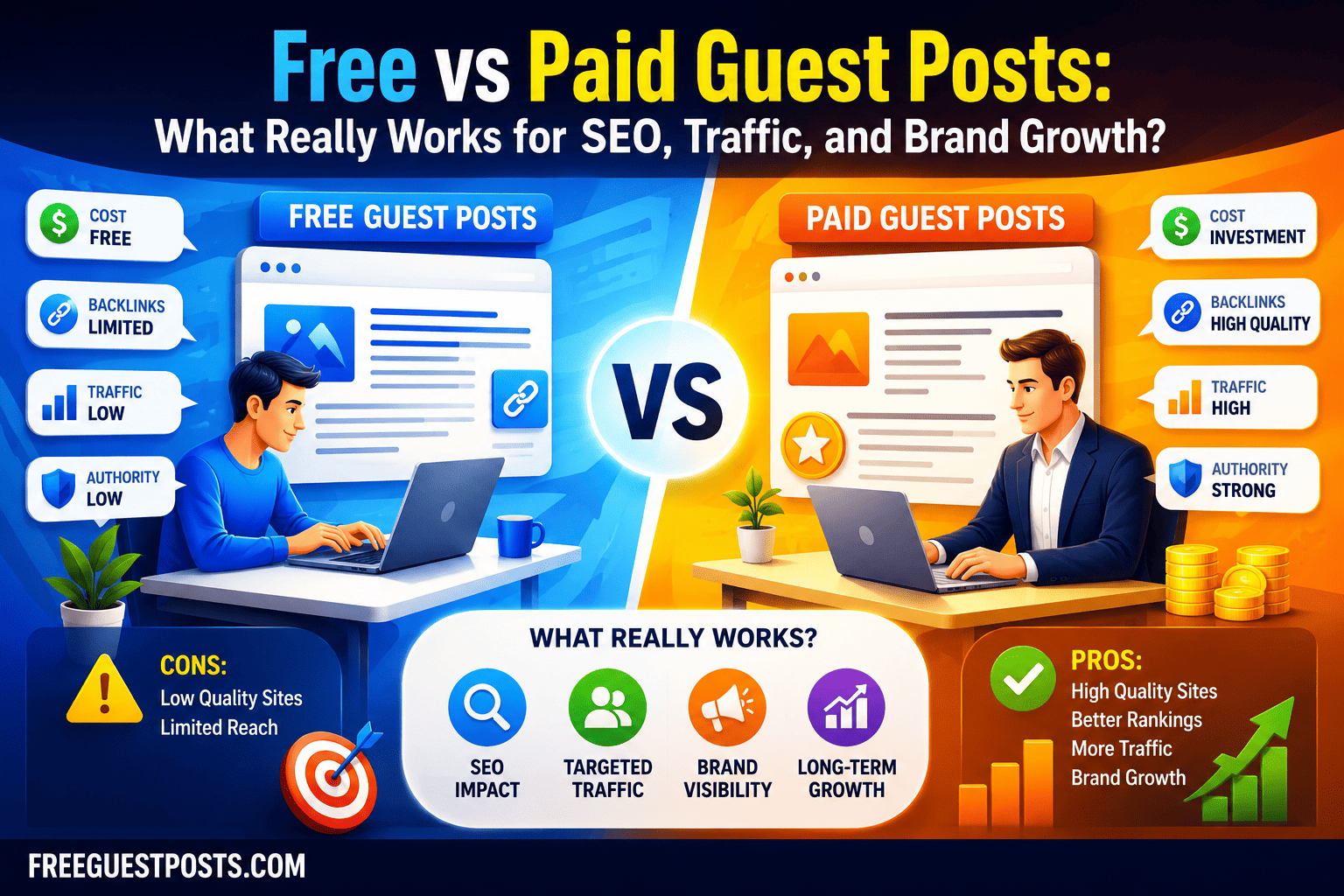
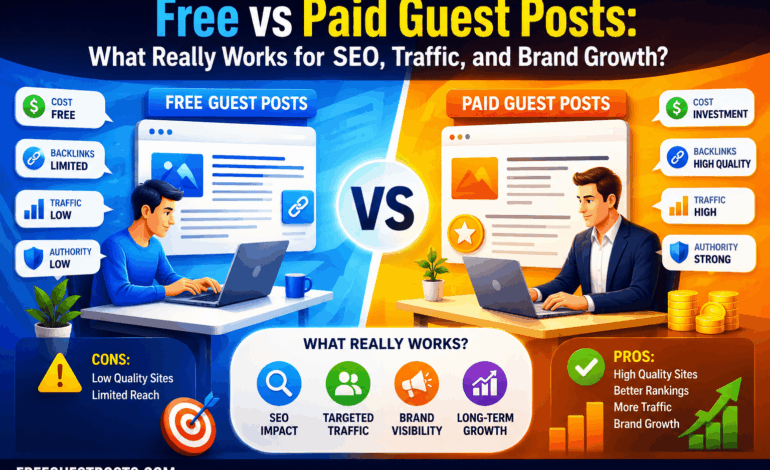
Free vs Paid Guest Posts: What Really Works for SEO, Traffic, and Brand Growth?

Let me be honest with you. I spent months trying to figure out whether I should pay for guest post placements or grind through free submissions and the answer I kept getting from “SEO gurus” was frustratingly vague. “It depends.” Great. Thanks.
So I dug into the actual numbers, talked to people who’ve done both, and tested it across real sites. What I found might surprise you, especially if you’re a small business owner, a startup founder, or a content creator who’s been told that paying for links is the only serious path to SEO growth.
Spoiler: it’s not. And I’ll show you exactly why backed by data, not opinion.
| 64.9% of link builders rely on guest posting as their primary backlink strategy |
97% more inbound links for sites that publish regular guest content |
$150–$500+ typical cost per paid guest post placement in 2026 |
3x faster organic traffic growth for startups using free guest posting in year one |
|---|
Key Takeaways
- Free guest posting works best for long-term SEO and authority building.
- Paid guest posting may provide faster placements but carries greater risks.
- Editorial standards matter more than whether a post is free or paid.
- Relevant backlinks outperform large volumes of low-quality placements.
- Reader value should always come before link acquisition.
What is Guest Posting, and why does it still matter in 2026?
Guest posting is writing and publishing an article on someone else’s website in exchange for a backlink, has been a cornerstone of SEO for over a decade. And despite Google’s evolving algorithms, it’s still working. In fact, it’s working better than ever when done right.
The reason is simple. Google still uses backlinks as one of its strongest ranking signals. A link from a relevant, trusted website tells Google: “This content is worth paying attention to.” That hasn’t changed. What has changed is the standard Google applies to those links.
Low-quality placements on irrelevant sites? Those can hurt you now. But a well-written article on a niche-relevant platform with editorial standards? That’s still pure SEO gold.
Over 60% of digital marketers rank guest blogging as their preferred off-page SEO strategy for earning quality backlinks in 2026. — Digital Marketing Material
Free vs Paid Guest Posts: What’s Actually the Difference?
Before we compare results, let’s be clear about what we’re talking about.
A free guest post is exactly what it sounds like you write a quality article, submit it to a platform that accepts guest contributions at no charge, and if it meets their editorial standards, it gets published with a do-follow backlink to your site.
A paid guest post is when you pay a website owner, a marketplace, or a broker to publish your article (or have them write one) with a backlink to your chosen URL. Costs typically range from $50 for low-tier placements to $500 or more for high-authority domains.
|
Free Guest Posting Recommended to start! Zero upfront cost |
Paid Guest Posting Use with caution! $50–$500 + per placement |
|---|
SEO Case for Free Guest Posting
Here’s something people overlook: the fact that a platform is free doesn’t mean it’s low quality. Editorial standards matter far more than price tags.
When you submit to a platform like freeguestposts.com which reviews every submission before publishing, you’re going through the same editorial gatekeeping that any quality paid platform applies. The difference is you’re not paying $200 for the privilege.
From an SEO standpoint, Google doesn’t care whether you paid for a placement. It cares about three things: relevance, trust, and the editorial quality of the site linking to you. A dofollow backlink from a free platform with genuine editorial oversight can outperform a paid link on a shady network every single time.
Less than 5% of available guest post opportunities meet quality standards (DR 71+ and 50K+ monthly organic traffic). Over 85% of paid placements fall into the low-quality tier. BuzzStream research
That stat should give every marketer pause. The majority of paid guest post placements available in the market are not just useless — they can actively harm your SEO. Google has gotten significantly better at identifying link schemes and low-quality networks. If you’re buying links from a private blog network, you’re rolling the dice on a Google penalty every single day.
What About Traffic and Brand Growth?
SEO is one thing. But guest posting has always been about more than just backlinks. It’s also a genuine audience-building tool.
When you publish on a relevant platform, you’re borrowing someone else’s audience. If the platform is in your niche, the readers are already interested in what you have to say. That’s why niche-specific categories matter so much when choosing where to submit.
B2B companies that incorporate guest posting into their content strategy generate 67% more leads per month compared to those that don’t. That’s not a backlink metric, that’s real pipeline. And you don’t need to spend a cent to get there if you’re strategic about where you publish.
For brand growth specifically, free guest posting has an underrated advantage: authenticity. A well-written guest article on a relevant site positions you as a thought leader with a good author profile credibility in your space. Readers engage with it organically, without the slightly awkward feeling that comes from obviously sponsored content.
When Paid Guest Posting Makes Sense?
I want to be fair here, because the honest answer isn’t “paid is always bad.” There are genuine use cases for paid placements, but they’re narrower than most people think.
Paid guest posting can make sense when you need a backlink from a very specific high-authority domain that doesn’t accept free submissions, when you’re running a time-sensitive campaign and need guaranteed publication, or when you’re in a highly competitive niche where top-tier links carry disproportionate ranking weight.
The key word is strategic. SEO professionals who see results from paid guest posts are buying one or two carefully vetted placements on genuinely authoritative sites with real traffic and strict editorial standards, not bulk-buying from link farms. As the research shows, one high-authority link outperforms dozens of weak ones. That principle applies regardless of price.
Publishing 2–4 high-quality guest posts monthly on relevant, authoritative sites produces optimal SEO results. Quality always outweighs quantity. Industry consensus, 2026
Hidden Cost of Paid Guest Posting Most People Ignore
Let’s talk money: not just the sticker price, but the real cost of a paid guest posting campaign.
At an average of $150–$300 per placement (and that’s mid-tier), a consistent campaign of four posts per month costs $600–$1,200 monthly. Over a year, that’s $7,200–$14,400 in link-building spend alone, before you factor in content creation costs.
For a startup or small business, that’s not a rounding error. That’s a hire. That’s three months of runway. And if even one of those placements ends up on a penalized domain, which happens more often than people admit, you’ve spent real money on something that now works against you.
Free guest posting carries none of that financial risk. The investment is time, not money. And time spent writing genuinely useful content compounds over years, the articles stay live, the backlinks keep passing authority, and your brand reputation grows with every piece you publish.
How to Scale Safely with a Free Platform
The smartest approach I’ve seen and what I’d recommend to anyone starting out, is to build your backlink foundation on free, editorially-reviewed platforms before you ever consider paying for placements.
Here’s why this matters from a Google perspective: natural link profiles grow gradually, across diverse domains, in relevant niches. A brand-new site that suddenly acquires 20 paid links in a month looks exactly like what it is, manipulation. A site that consistently publishes on quality platforms over 6–12 months looks like a brand that people want to reference. That’s the profile Google rewards.
A platform like free guest posts covers 25+ niches, applies editorial review to every submission, and publishes with dofollow backlinks all at zero cost. It’s not a link farm. It’s a structured content platform that gives you exactly what Google wants to see: relevant, editorially-approved, contextual backlinks built over time.
Start there. Build your profile. Get your first 10–15 quality backlinks without spending a penny. Then, if your strategy calls for it and your budget allows you can layer in highly selective paid placements on top of a healthy, natural-looking link profile.
Free vs Paid Guest Posts: the Honest Verdict
If you’re a startup, a small business, a freelancer, or anyone operating without a dedicated SEO budget, free guest posting isn’t just a good option, it’s the right starting point. It’s lower risk, more sustainable, and produces real results when you’re consistent.
If you’re an established brand with budget and a specific authority target in mind, a handful of premium paid placements can complement a healthy backlink profile. But they should complement it not replace the organic foundation underneath.
The question was never really “free or paid.” It was always “quality or not.” And the good news is that quality, editorially-reviewed, niche-relevant guest posting is available to everyone for free.
Ready to start building?
Submit your first guest post on freeguestposts.com no fees, no gimmicks, just real dofollow backlinks in your niche. Your first submission could be live within 3–5 business days.
And if you’re still unsure which niche fits your content, browse all 25+ accepted categories to find your best match before you write a single word.
FAQs
1. Is Free Guest Posting as effective as Paid for SEO?
Yes! When the free platform applies genuine editorial standards, a do follow backlink from a free guest post carries the same SEO weight as one from a paid placement. Google evaluates the quality, relevance, and trustworthiness of the linking site, not whether money changed hands. Platforms like FreeGuestPosts.com, which review every submission, produce backlinks that are fully SEO-compliant and penalty-safe.
2, How much does a paid guest post typically costs in 2026?
Paid guest post pricing ranges from $50 for low-authority placements up to $500 or more for high-DA sites with real traffic. Mid-tier placements typically cost $150–$300 per article. When you factor in content creation costs, a consistent paid campaign can run $7,000–$15,000 per year compared to $0 for a well-executed free guest posting strategy.
3. Can paid guest posts get my site penalized by Google?
Yes, if the placement is on a low-quality site, a private blog network (PBN), or a site that Google considers a “link scheme.” Google’s algorithms have become significantly better at detecting manipulative link building. Placements from spam networks, sites with no real traffic, or sites that accept every submission without editorial review carry real penalty risk. Free platforms with editorial oversight are generally safer.
4. How long does it take to see SEO results from Guest Posting?
Referral traffic typically appears within days of publication. SEO benefits improvements in keyword rankings and domain authority — usually show up within 4–8 weeks. The full organic traffic effect is best measured at the 3–6 month mark. Consistent guest posting over 6–12 months produces the most sustainable results.
5. What niches does Free Guest Posts accept?
FreeGuestPosts.com accepts guest posts across 25+ niches including Business, Technology, Health, Travel, Fashion, Finance, Education, Lifestyle, DIY, Software, and more. Every approved post is published with a dofollow backlink to your chosen URL. You can browse all accepted categories at freeguestposts.com/categories/ before writing.
6. How many guest posts should I publish per month?
Industry data suggests 2–4 high-quality guest posts per month is the optimal cadence for most sites. Consistency matters more than volume a steady stream of quality posts across relevant platforms builds a natural-looking backlink profile that Google rewards. Avoid the temptation to bulk-publish, especially on paid networks, as this can trigger spam signals.
7. Is guest posting still worth it in 2026?
Absolutely. Guest posting remains one of the most effective off-page SEO strategies in 2026. Over 60% of digital marketers consider it their preferred method for earning quality backlinks. The key shift is that quality now matters far more than quantity. A handful of well-placed, editorially-approved guest posts on relevant sites produces far better results than dozens of low-quality placements: free or paid.
Create a Free Contributor Account and Submit Original Content through Free Guest Posts Portal.